

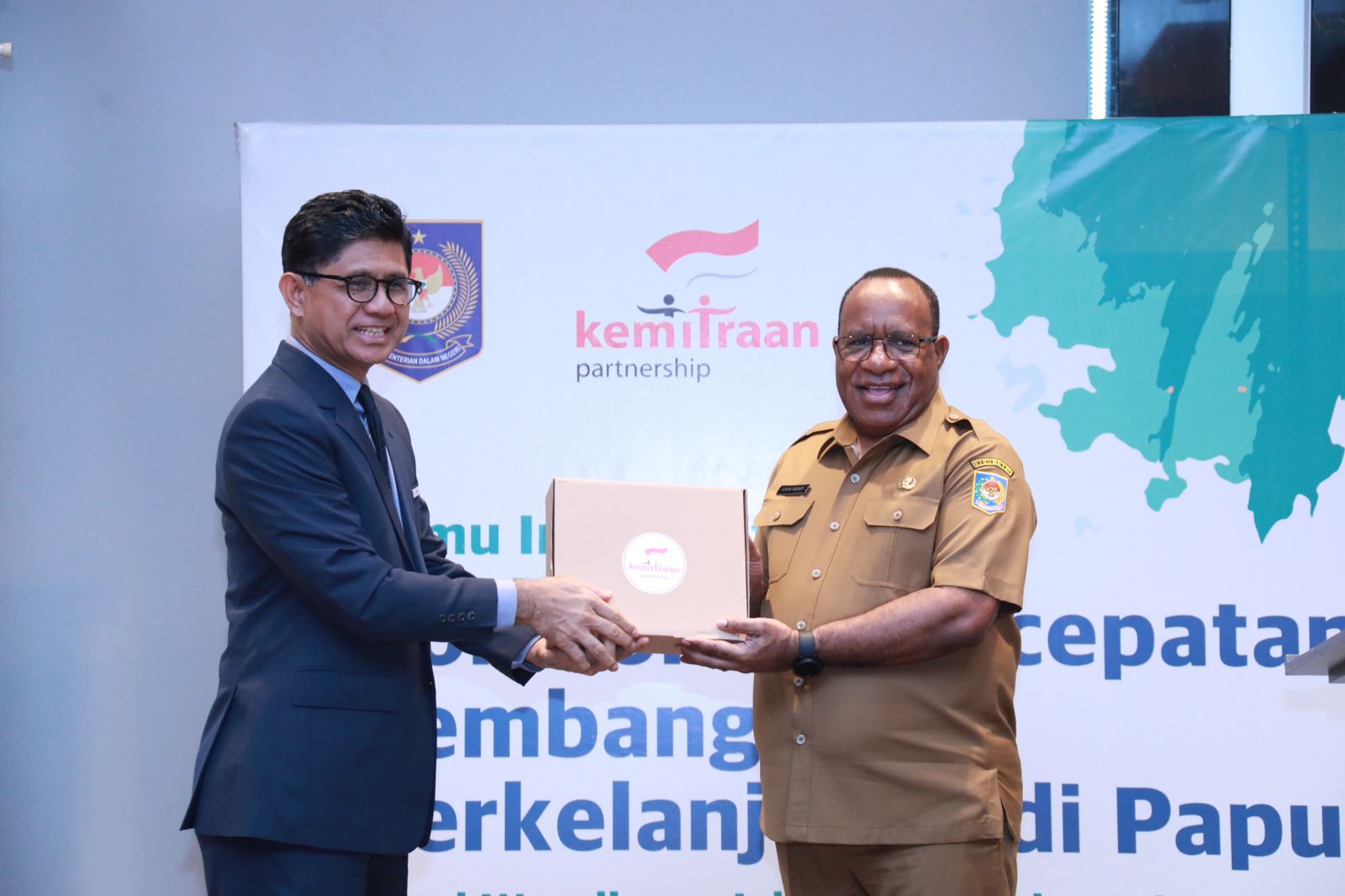
Vice Minister of Indonesian Home Affairs, John Wempi Wetipo directly opens an interactive dialogue with the theme of “Encouraging the Institutionalization of Sustainable Development in Papua” which was presented by Partnership for Governance Reform (KEMITRAAN) NGO.
In those meeting, Wempi says that continuous development is part of global issues that in concept is really neccessary for present and future generations. The development is expected to be able in balancing social, economy, environmental development simultaneously.
“This means that it will continue to the upcoming generations, not only on road developments. Thus, I thought KEMITRAAN is how we build a collaboration between ministry and insitution. If it’s only us, we wouldn’t be able,” he says when giving his remarks at Wyndham Hotel, Jakarta, Tuesday (28/2).
Wempi explained that the implementation of continuous development concept in Indonesia has been described in Law Number 32 of 2009 concerning Environmental Protection and Management and Presidential Regulation Number 111 of 2022 concerning Implementation of Achieving Sustainable Development Goals. The two laws will be the anchor for the central and local government in managing environment and continuous development.
“This is our duty and responsibility, not just the government, but all of us in how realizing this mission in the future and seeing this goes well,” said Wempi.
However, it has to be admitted that Papua has several issues, such as ineffective coordination between institutions. To overcome it, government has formed Steering Committee for the Acceleration of Development of Special Autonomy in Papua (BP3OKP) whose task is to synchronize, harmonize, evaluate, and coordinate.
“For this development that we really put our hope to, we have formed a special agency in Papua, namely BP3OKP. The one who leads it is the Indonesian Vice President and we have several talks with him on how to accelerate the development in Papua,” told Wempi.
On the other hand, the Executive Director of KEMITRAAN Laode M. Syarif hopes that the development in Papua would not cause any environmental damage as it happened in other regions. He stressed that those mistakes should be repeated.
He then hopes that Papua development model could push environmental preservation by taking into account environmental connectivity and low-carbon development.
He said that international talks on carbon need to be discussed further in order to preserve the nature, which eventually would impact the people.
“So that low carbon development in Papua could be realized,” he said.