

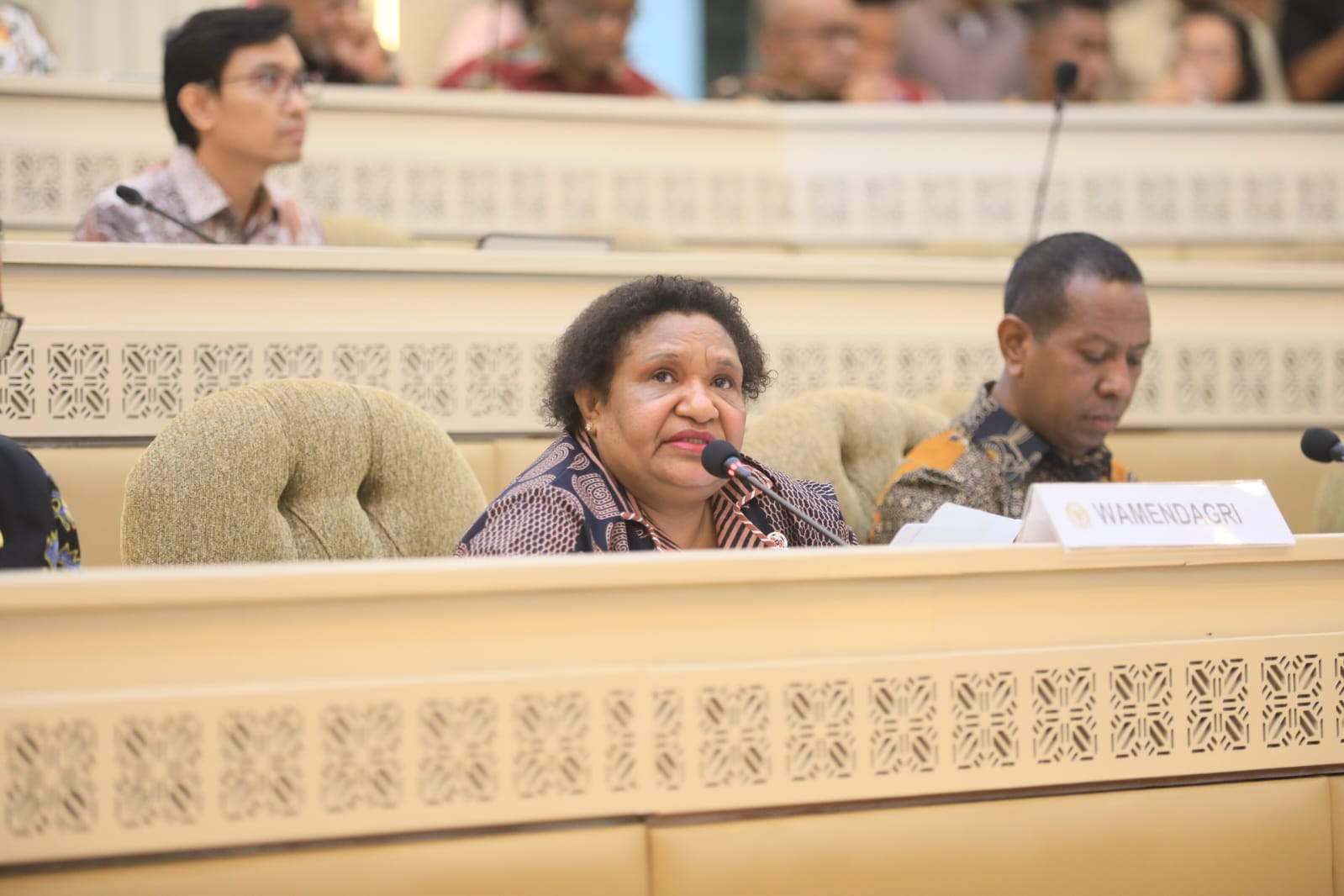
papuachronicle.co – Jakarta. Vice Minister of Home Affairs Ribka Haluk attended a Shearing Meeting (RDP) with Commission II of the Indonesian House of Representatives, Thursday (13/3/2025). In the meeting, she conveyed the latest developments in government development in the four New Autonomous Regions (DOB) of Papua.
Ribka explained that the formation of the four Papuan DOBs, which include South Papua, Central Papua, Mountainous Papua, and Southwest Papua, is based on four Laws (UU). The four are Law Number 14 of 2022, Law Number 15 of 2022, Law Number 16 of 2022, and Law Number 29 of 2022. Based on these regulations, the central government has the authority to provide guidance and facilitation within three years since its inauguration.
“Maybe this year is also the last year [the central government carries out coaching and facilitation] where the regional government already has a definitive governor so I think it will exist in the implementation of facilitation and so on,” said Ribka representing the Minister of Home Affairs (Mendagri) at the RDP held in the DPR RI Commission II Meeting Room.
She said, in terms of the progress of the development of facilities and infrastructure, the four DOBs already have a masterplan. Meanwhile, in terms of filling the state civil apparatus (ASN), efforts are currently being made so that 80 percent of them are Indigenous Papuans (OAP).
Ribka explained, since the beginning of the formation of the four Papua DOBs, the Ministry of Home Affairs (Kemendagri) has made many coaching and facilitation efforts. This includes facilitation in the implementation of 12 roadmap agendas that have begun before the inauguration of the region and the inauguration of the Acting Governor.
“The Minister also led the meeting directly, was always consistent, [provided] assistance. Even a quarterly evaluation was carried out on the performance of the Acting Governor, and the Acting Governor. Respective regents [in the Papuan Autonomous Region],” he added.
She revealed that other efforts made were to form a government administration assistance team to strengthen coordination at the central level in the development of the Papuan Autonomous Region. Then, regulations and technical guidelines were also prepared so that the administration of government would run smoothly.
In addition, she said, the Ministry of Home Affairs is actively building coordination with parent regions, autonomous regions, and regencies/cities in the area to discuss problems that arise during the transition period. Finally, the Ministry of Home Affairs is also encouraging technical ministries to prepare specific Norms, Standards, Procedures, and Criteria (NSPK) with reference to the Papuan context.
“And we also ask for support, input, and constructive suggestions so that we can jointly provide welfare for the people of Papua in accordance with the mandate of the constitution,” she said.